Dog Vision – Everything You Wanted to Know
Related reading: I Died Today – Duke’s Touching Story.
For general pet-health questions, the AVMA pet-owner resources are a reliable starting point, and your veterinarian should guide individual decisions.
Dogs are not just our best friends; they are also creatures of fascinating abilities and characteristics, among which their vision stands out as a subject of curiosity and misunderstanding. Many dog owners wonder how their furry companions see the world. Do they see in black and white, or can they perceive colors? How well can they see in the dark? Understanding dog vision is essential for pet owners who wish to cater to their pets’ needs better and foster a deeper connection with them. This article aims to demystify dog vision, providing insights into everything you wanted to know about how your canine friend perceives the world around them.
The Evolution of Canine Vision
To understand dog vision, it’s essential to look at their evolutionary background. Dogs, descending from wolves, are primarily nocturnal hunters. This ancestry has influenced their vision significantly. Evolution has equipped dogs with eyesight adapted to low light conditions, allowing them to detect movement and navigate in the dark efficiently. However, these evolutionary adaptations have also led to trade-offs, particularly in color perception and detail resolution.
How Dogs See the World: Color Perception
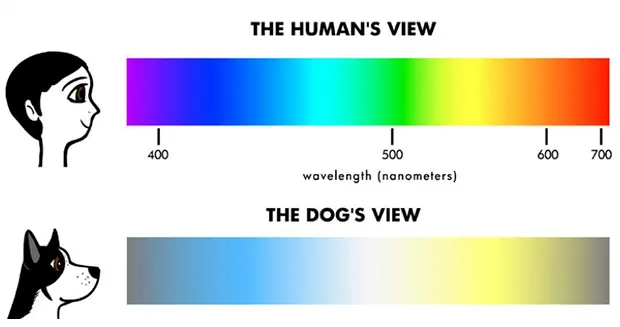
One of the most common misconceptions about dog vision is that dogs see in black and white. This is not entirely accurate. While dogs do not see the full color spectrum like humans do, they can perceive colors, albeit differently. Human eyes contain three types of cone cells, enabling us to see a broad spectrum of colors. Dogs, on the other hand, have only two types of cone cells. This dichromatic vision means dogs can see in shades of blue and yellow but cannot distinguish between red and green, which appear as shades of gray.
Night Vision and Motion Detection
Dogs excel in night vision and motion detection, thanks to the unique structure of their eyes. The canine eye has a high concentration of rod cells, which are more sensitive to light and motion than cone cells. This makes dogs particularly adept at noticing moving objects, even in low light conditions. Additionally, dogs have a reflective layer behind their retinas called the tapetum lucidum, which acts like a mirror, reflecting light back through the retina. This enhances their ability to see in the dark, giving their eyes a distinctive glow when illuminated at night.
Field of View and Depth Perception
Dogs have a wider field of view compared to humans. The placement of their eyes on the head provides them with a panoramic view, allowing them to monitor a larger area for potential threats or prey. However, this wider field of view comes at the cost of reduced depth perception. Dogs rely more on movement than on static details to perceive depth. Despite this limitation, dogs can still gauge distance effectively, especially when objects are moving.
Vision Across Different Breeds
It’s important to note that vision can vary significantly across different dog breeds. Breeds with longer noses, for example, have a broader field of view but less binocular overlap, affecting their depth perception. Conversely, breeds with shorter noses, like bulldogs or pugs, have a narrower field of view with greater binocular overlap, enhancing their depth perception. Additionally, certain breeds are more prone to vision problems and diseases, emphasizing the need for regular veterinary eye examinations.
https://www.youtube.com/watch?v=A0\_uj\_Fglys&pp=ygUKZG9nIHZpc2lvbg%3D%3D
Enhancing Your Dog’s Visual Environment
Understanding dog vision can help pet owners create a more stimulating and safe environment for their dogs. For instance, knowing that dogs see better in low light can encourage owners to provide nighttime activities or toys that cater to their vision. Similarly, understanding that dogs see certain colors more vividly can influence the choice of toy colors to enhance visibility and engagement.

Conclusion
Dog vision is a complex and fascinating subject that reflects the intricate balance between evolutionary adaptations and environmental demands. While dogs may not see the world with the same clarity and color richness as humans do, their vision is perfectly tuned to their needs as highly skilled hunters and companions. By gaining insights into how dogs perceive the world, we can better understand and connect with our furry friends, ensuring their well-being and happiness.
Understanding the intricacies of dog vision not only deepens our appreciation for the canine companions in our lives but also equips us with the knowledge to provide better care and enrichment for them. As we continue to uncover more about the sensory perceptions of dogs, we open new avenues for enhancing the human-canine bond, making every shared moment more meaningful.


