Best Interactive Dog Toys to Challenge Their Brain
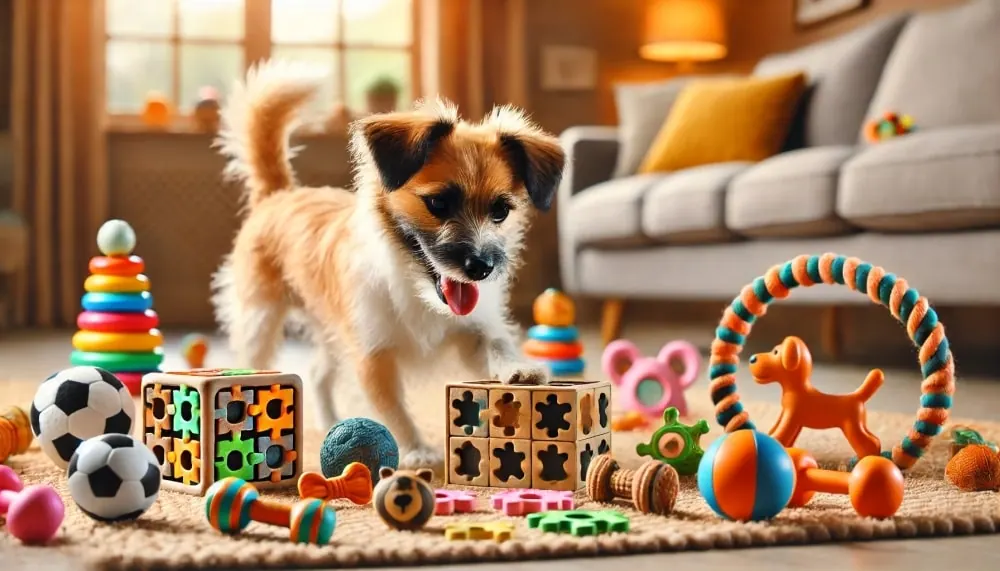
An interactive dog toy is less about bells and lights and more about giving your dog a job. Sniffing out kibble in a snuffle mat, sliding a block to uncover a treat, or nosing a wobbling feeder around the kitchen can tire a dog out in a way a second walk sometimes cannot. The right game depends on the dog in front of you: a food-motivated puzzle beginner, a scent hound who wants to forage, a fast eater who needs to slow down, or a gentle player who likes hide-and-seek plush.
If you are wrapping an interactive toy as a Christmas gift, our Christmas gifts for dogs guide puts puzzles and stuffable toys in that holiday context, with safety notes on chocolate, xylitol, and tinsel.
Play and enrichment work best alongside sound training habits; the AKC expert advice on dog training is a useful overview.
As an Amazon Associate, we earn from qualifying purchases.
Quick picks
- Best starter puzzle (no loose parts): Nina Ottosson Hide N’ Slide — a level-2 board with sliding blocks and flippers that stay attached.
- Best moving treat dispenser: KONG Wobbler (medium/large) — a weighted feeder that wobbles and rolls as kibble comes out.
- Best scent work: Pet Parents Forager snuffle mat (19”) — a washable mat for hiding kibble in fabric folds.
- Best slow-feeder bowl: Outward Hound Fun Feeder Slo Bowl (11.8”, swirl) — a 4-cup maze bowl for medium and large dogs.
- Best chew-and-work hybrid: West Paw Qwizl (large) — a tough, stuffable tube for treats or a dental chew.
- Best hide-and-seek plush: Outward Hound Hide-A-Squirrel (XL) — a soft tree trunk with removable squeaky squirrels, for gentle players only.
These are researched recommendations, not a lab test or a multi-dog trial we ran ourselves. They showed up repeatedly in recent expert roundups, match how trainers usually introduce enrichment, and had live, in-stock Amazon listings at the time of writing. Puzzle toys are not chew toys. Stay in the room, start easy, and put the game away when the food is gone.
Best interactive dog toys by type
1. Best puzzle toy: Nina Ottosson Hide N’ Slide (Level 2)
Who it’s for: Dogs that already understand “food can be hidden,” including many puppies and adults new to board puzzles. If your dog has never used a puzzle, start with some compartments uncovered so the game is obvious.
This 11.6-inch level-2 board is a frequent trainer and reviewer pick because the sliding blocks and swivel flippers stay attached. That is a practical advantage over lift-the-lid puzzles with removable pieces, which some dogs try to chew. There are about 14 treat spots in total, and the board holds roughly a quarter cup of kibble or small treats, so it is better as a game or a meal top-off than a full dinner for a large dog. You can make it easier by leaving flippers open, or harder by hiding food inside the sliding blocks.
Pros: No loose parts; adjustable difficulty; easy to rinse; made from food-safe composite without BPA, PVC, lead, or phthalates, according to the manufacturer.
Cons: A quarter cup will not replace a full meal for many dogs; clever dogs may flip the whole board; it is still plastic, so it will not survive a determined chewer if you leave it out.
Safety notes: Teach the game, then supervise. Do not let your dog chew the board. If a piece cracks or comes loose, retire it. Store it when it is empty.
Check price on Amazon: Nina Ottosson Hide N’ Slide Puzzle
2. Best treat-dispensing toy: KONG Wobbler (Medium/Large)
Who it’s for: Food-motivated dogs that like to chase, paw, and pounce, especially at mealtime. This listing is the larger Wobbler, generally aimed at medium and large dogs. KONG also makes a smaller version for dogs roughly 25 pounds and under.
The Wobbler looks like an oversized KONG on a weighted base. It stands upright until your dog nudges it, then it wobbles, spins, and rolls, dropping kibble or treats from a hole as it goes. You unscrew it to fill and clean it, and it is dishwasher-safe. Many trainers like it as a slow-feeding alternative to a bowl because the dog has to work for each piece. It can be loud on hard floors and may scuff walls, which is worth knowing if you live in an apartment.
Pros: Turns a meal into a moving game; challenging even after the dog knows the toy; sturdy enough for most mealtime use; easy to fill and clean.
Cons: Noisy on tile or hardwood; too large or too bouncy for some small dogs and tight spaces; it is a hard plastic feeder, not a heavy-chew toy to leave with a power chewer.
Safety notes: Use kibble or treats large enough not to become a choking risk, and small enough to come out of the hole. Supervise early sessions, and take it away if it cracks or if your dog starts chewing the rim.
Check price on Amazon: KONG Wobbler, Medium/Large
3. Best snuffle mat: Pet Parents Forager (Meadow, 19”)
Who it’s for: Dogs that prefer sniffing to sliding plastic pieces, including seniors, scent hounds, and dogs that get frustrated by board puzzles. The 19-inch size gives most dogs more room to search; a 12-inch version exists if you want something smaller or more portable.
A snuffle mat hides kibble or dry treats in fabric “grass,” so your dog uses their nose to forage. That is mentally tiring work, and it can also slow down a dog that otherwise vacuums a bowl. The Forager is a repeated expert pick for this category: it has a non-slip backing, a soft snout-friendly texture, and it can be machine-washed. Use dry food only if you want to keep laundry reasonable. This is an enrichment mat, not a tug toy or a chew toy. For a full comparison of large mats, travel cinch mats, and what to use if your dog chews fabric, see our snuffle mats buying guide.
Pros: Easy, low-impact mental work; useful at mealtime; washable; no hard edges or small puzzle pieces.
Cons: Wet or smeary food makes a mess; some dogs try to shred the fabric; it is not a good “leave them alone with it” item if your dog eats cloth.
Safety notes: Watch the first sessions. If your dog starts ripping or swallowing fabric, stop and switch to a different feeder. Shake out crumbs and wash regularly so the mat does not get sour or moldy.
Check price on Amazon: Pet Parents Forager Snuffle Mat, 19”
4. Best slow-feeder bowl: Outward Hound Fun Feeder Slo Bowl (11.8”, Swirl)
Who it’s for: Medium and large dogs that eat too fast. This 11.8-inch swirl bowl holds about 4 cups of dry or wet food. Outward Hound also makes smaller bowls and different maze patterns if your dog is small or needs an easier or harder design.
A slow feeder is one of the simplest interactive tools you can add to mealtime. The ridges force the dog to work around the pattern instead of swallowing dinner in a few gulps, which can help with gulping, regurgitation, and the discomfort that comes from eating too fast. It will not, by itself, prevent bloat, and it is not a substitute for veterinary advice if your dog has a history of gastric dilatation-volvulus. Use it on a non-slip surface, start with a simpler pattern if your dog gets frustrated, and wash it after wet food. For a comparison of 2-cup and 4-cup bowls, a stainless insert option, and a lick-tray alternative, see our slow feeder bowls guide.
Pros: Straightforward daily use; large capacity; works with kibble or canned food; no loose parts; dishwasher-friendly, according to the manufacturer.
Cons: This size is bulky for small dogs; some dogs tip or skip ridges to eat faster anyway; wet food can lodge in the grooves if you do not clean it well.
Safety notes: The bowl should be stable and wide enough that your dog is not ramming their face into a tight gap. Inspect for chewed plastic. If your dog has a medical condition that affects eating, ask your veterinarian before you change how meals are offered.
Check price on Amazon: Outward Hound Fun Feeder Slo Bowl, 11.8” Swirl
5. Best chew-and-work hybrid: West Paw Qwizl (Large, Tangerine)
Who it’s for: Dogs that want to gnaw and also work for food, including many strong chewers. The large size suits a bigger mouth; West Paw makes a smaller Qwizl if that is a better fit.
The Qwizl is a hollow, bone-shaped Zogoflex tube made in the United States. You can stuff it with kibble or a soft filling, or slide in a bully stick or dental chew so the dog has to work to reach it. That combination — a durable chew plus a puzzle — is why it shows up on enrichment lists as well as tough-toy lists. It floats and is dishwasher-safe. West Paw also advertises a replacement program for Zogoflex toys; check the current terms. It is still not indestructible, and a bully stick itself should be sized and supervised carefully.
Pros: Tough enough for many serious chewers; stuffable in more than one way; easy to clean; made in the USA from a recyclable material, according to the manufacturer.
Cons: Costs more than a basic puzzle board; some dogs lose interest if it is not stuffed; a determined chewer can still damage it.
Safety notes: Size it so it cannot lodge in the back of the mouth. If you add a chew stick, the stick should be too large to swallow and should come out when it gets short. Take the Qwizl away if it is punctured or developing sharp edges.
Check price on Amazon: West Paw Qwizl, Large, Tangerine
6. Best hide-and-seek plush: Outward Hound Hide-A-Squirrel (XL)
Who it’s for: Gentle players, puppies that like to “hunt” a soft toy, and dogs that enjoy squeakers but are not trying to disembowel every plush in the house. The XL trunk comes with more removable squirrels than the smaller sizes.
This is a classic foraging toy: squeaky plush squirrels hide in a fabric tree trunk, and your dog pulls them out. It can be a great interactive game if you play it with your dog and put it away when play is over. It is not a tough chew, and it is a poor choice for a stuffer-ripper. Reviews are full of dogs that love it and just as many stories of shredded squirrels. If your dog is a heavy chewer, skip this and use a snuffle mat or a rubber puzzle instead.
Pros: Clear, instinctive game; easy to re-hide the squirrels; a fun way to play together; inexpensive compared with electronic toys.
Cons: Poor durability for chewers; squeakers, fabric, and stuffing are a swallowing risk once something tears; the “squirrels” are easy to lose under furniture.
Safety notes: Supervise the whole time. If a seam splits, a squeaker pops out, or stuffing appears, take the toy away. Do not leave a dog alone with this one.
Check price on Amazon: Outward Hound Hide-A-Squirrel, XL
How we chose these toys
We looked at what people actually need when they search for “best interactive dog toys”: a puzzle they can start with, a treat dispenser for mealtime, a sniffing option, a slow feeder, and a clear warning about plush toys that look interactive but are not tough. Recent expert roundups — including pieces from Whole Dog Journal, The Spruce Pets, Preventive Vet, and CNN Underscored — keep coming back to Nina Ottosson boards, the KONG Wobbler, snuffle mats, and slow feeders, and they stress supervision. Veterinarians quoted in those pieces often recommend food puzzles as a way to fight boredom, not as a substitute for walks, training, or medical care.
From there, we picked well-known products in each category, confirmed each Amazon listing was live and in stock, and wrote up honest trade-offs (noise, capacity, chewing risk, and toys that should never be left out). We did not run our own multi-week test, and we are not claiming a veterinary endorsement of this specific list. If your dog resource-guards food, swallows non-food items, or has dental disease, ask your veterinarian or a qualified trainer before you introduce a new game.
How to use interactive toys well
Start easier than you think. A frustrated dog may flip the board, chew it, or walk away. Leave some compartments open, use higher-value treats at first, and celebrate easy wins.
Supervise, then put the toy away. Puzzle boards, snuffle mats, and plush hide-and-seek toys are for time with you, not for crate-time chewing.
Match the food to the toy. Dry kibble or small training treats work in most of these. Wet, sticky fillings belong in toys designed for them, and they need cleaning afterward. For smearable foods, a lick mat is often a simpler starting point than a board puzzle, provided you stay in the room and the dog licks rather than chews the mat.
Rotate. Dogs get bored with the same puzzle. Two or three options, used on different days, usually last longer than a big pile of toys left on the floor.
This is not a substitute for a walk or training. Mental work helps, especially on rainy days or for dogs that cannot exercise as hard as they used to. It does not replace social time, physical activity your veterinarian considers appropriate, or help for anxiety.
If you also need everyday chew or fetch toys, see our best dog toys guide, which is organized by play style, including chewers, puppies, and seniors.
Frequently asked questions
If you take one thing from this list, let it be this: pick a game your dog can win, stay in the room, and put it away when the food is gone. That habit matters more than owning a large collection of “brain toys.”