Could a Service Dog Really Be Helpful for Children with Autism?
Related reading: Medical Emergency: Head Pressing Could Be Fatal to Your Dog.
For general pet-health questions, the AVMA pet-owner resources are a reliable starting point, and your veterinarian should guide individual decisions.
In the realm of support for children with autism, therapies and aids come in various forms, ranging from behavioral therapy to technological devices. Among these, service dogs stand out as a uniquely compassionate and dynamic form of support. But the question remains: Could a service dog truly benefit a child with autism? This article explores the benefits, challenges, and considerations surrounding the use of service dogs for children on the autism spectrum.
The Role of Service Dogs
Service dogs are specially trained animals that assist individuals with disabilities in performing tasks that they may find difficult or impossible. For children with autism, these dogs are trained to provide not only physical assistance but also emotional support, which can play a crucial role in their daily lives. These dogs are adept at handling their partner’s unique needs, often responding to signs of emotional distress and helping to mitigate the effects of sensory overload—a common challenge for children with autism.
Training and Certification Process for Service Dogs Assisting Children with Autism
Service dogs for children with autism undergo a specialized training regimen that is both comprehensive and tailored to meet the unique needs of their future handlers. The process of training and certifying these dogs is meticulous, ensuring that they are not only effective in their roles but also safe and reliable companions for children with developmental challenges. This section will explore the training techniques, certification standards, and the oversight involved in preparing a service dog for work with a child with autism.
Training Techniques
The training of service dogs for children with autism begins when the dogs are puppies. Organizations typically select breeds known for their calm demeanor, intelligence, and ability to form strong bonds with humans, such as Labrador Retrievers, Golden Retrievers, and German Shepherds. The initial phase of training involves basic obedience and socialization, where puppies learn to follow commands and become accustomed to a variety of social settings and stimuli. This foundation is crucial for ensuring the dog remains composed and obedient in diverse environments.
As the dogs mature, their training becomes more specialized. Trainers begin to introduce scenarios that specifically mimic situations the dogs might encounter while assisting a child with autism. This includes training to recognize and respond to signs of anxiety or emotional distress in their handler. For instance, a service dog might learn to gently nudge a child to distract them from a stressful situation or lie on their lap to provide comforting pressure. This type of intervention can be instrumental in preventing or de-escalating emotional meltdowns.
Another critical area of training involves safety and wandering prevention. Service dogs are taught to act as an anchor if a child attempts to wander off, or how to track and locate a child quickly if they do manage to leave a safe area. This training involves both leash work and off-leash commands to ensure the dog can effectively control situations that could pose a risk to the child’s safety.
Certification Standards
Once a service dog has completed their training, they must pass a series of evaluations to become certified. These evaluations test the dog’s ability to perform specific tasks that assist the child, as well as their behavior in public settings. Certification criteria often follow standards set by organizations such as Assistance Dogs International (ADI) or local equivalents that ensure the dogs are capable of performing their duties reliably under various conditions.
The certification process also includes assessments of the dog’s temperament and how they react to distractions and potential stressors. A service dog must remain calm and responsive in crowded places, during sudden loud noises, and when meeting new people. Only those dogs that demonstrate they can handle these pressures competently are certified.
Benefits of Service Dogs for Children with Autism
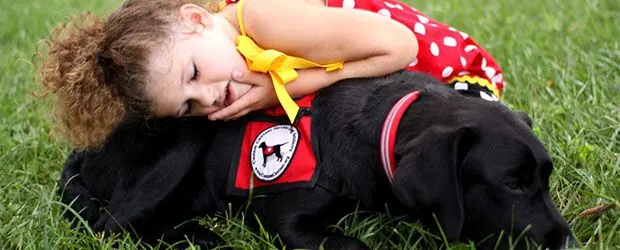
- Emotional Connectivity and Socialization: One of the significant challenges for children with autism is difficulty in social interaction and forming emotional bonds with others. Service dogs can bridge this gap. Their constant presence offers a comforting, non-judgmental companion that can reduce feelings of anxiety and stress. The interaction with a dog can also serve as a social bridge, facilitating easier interactions with peers and adults, as the dog often attracts attention and serves as a conversational catalyst.
- Enhanced Safety: Children with autism may sometimes exhibit wandering behaviors, which can pose significant safety risks. Service dogs are trained to keep children safe, either by tethering to them and acting as a gentle anchor or by alerting parents if the child attempts to wander. This aspect not only enhances the child’s safety but also significantly reduces parental anxiety.
- Routine and Structure: Service dogs require regular feeding, grooming, and exercise, routines that can help a child with autism understand and maintain schedules. This daily structure can help reduce the child’s anxiety by providing predictable and consistent activities.
- Crisis Management and De-escalation: Many service dogs are trained to recognize signs of emotional distress or meltdowns and respond appropriately to soothe the child. They might use techniques such as applying gentle pressure to calm the child, a method akin to deep pressure therapy, which is known to be beneficial for children with sensory processing difficulties.
Challenges and Considerations
While the benefits are significant, there are challenges and considerations that families must take into account:
- Cost: Training a service dog is expensive, often ranging from $15,000 to $30,000. This cost can be prohibitive for many families, although some organizations provide dogs at a reduced cost or for free.
- Long-term Commitment: Acquiring a service dog is a long-term commitment, both in terms of time and resources. Families must be prepared for the added responsibilities of caring for a dog, including veterinary visits, feeding, and daily exercise.
- Finding the Right Match: Not every service dog is a perfect fit for every child. The matching process is critical and can be lengthy, as it must ensure that the dog’s temperament aligns with the specific needs and environment of the child.
Service dogs offer a plethora of benefits for children with autism, providing not only companionship and unconditional love but also a range of practical supports that can significantly improve the quality of life and safety of these children. However, the decision to get a service dog should be made with careful consideration of the child’s needs, family’s capacity to manage a service animal, and financial implications.
Families considering a service dog for their child with autism should consult with healthcare providers, speak with other families who have gone through the process, and connect with reputable organizations dedicated to training service dogs for people with disabilities. With the right support and preparation, a service dog can indeed be a transformative addition to the life of a child with autism.